The Orbital Vats & The Reckoning
“A copper doesn’t bury eighty-eight thousand murder victims to buy himself a pension.”
From the base of the North Rim anchor station, the Orbital Transfer Tether didn't look like a piece of engineering; it looked like three threads of black spider-silk blown straight up into the violet haze and caught on a star.
Inside the cramped, two-metre-square stevedore gang-pod bolted behind the fifty-tonne platinum ingot sled, there were no passenger seats—only four canvas web-straps rigged across a dented aluminum bulkhead that smelled of hydraulic oil and stale chewing tobacco.
Tariq Sabir—twenty-seven, built like a pit-pony like his sister, with a scarred four-claw titanium prosthetic where his left hand had been before a counterweight cable parted last winter—slammed the outer pressure hatch down and spun the locking wheel home with his steel claw.
"Finch's gold key cleared the automated manifest interlock," Tariq said, checking the green pressure gauge beside the gasket before pulling himself into the web-harness next to Mairead. "As far as the Spire traffic computer knows, this climber is carrying fifty tonnes of refined dysprosium and two maintenance riggers up to the zero-gee transfer collar. Once the linear induction motors kick in, you're going to pull three-point-four gees for the first four minutes until we clear the stratosphere. Keep your chin down and your teeth together, Inspector—it's hard on Earther necks."
"I'll manage," Vance said, cinching the canvas harness tight across his wool coat.
Through the six-inch quartz bullseye pothole beside his shoulder, Vance saw the warning strobes along the launch trench flash from amber to blinding white.
Then the magnetic catapult let go.
There was no engine roar—only an almighty, chest-flattening hum as twelve gigawatts of geothermal current hurled the seventy-tonne sled straight up the middle carbon-nanotube ribbon at two hundred metres per second squared.
The lead-doped slag-glass roofs of New London dropped away beneath them like a stone kicked off a pier.
Pressed deep into the canvas webbing while the 3.4g load pulled the skin tight across his cheekbones, Vance kept his eyes fixed on the little round quartz window.
In thirty seconds they punched clean through the permanent bank of purple dust-squalls hanging over the Terminator Rift. In ninety seconds, the sky outside the glass turned from bruised rust-red to hard, airless indigo, and then to the pitiless velvet black of deep space.
For the first time in fourteen months, Arthur Vance saw Proxima Centauri b from the outside.
It wasn't a welcoming blue marble like the photographs of Earth hanging in the Whitehall schools. Below them rolled a gigantic, scarred ball of iron and rock—its eastern half a blinding, furnace-white wasteland of dry basalt baking under the huge crimson eye of the red dwarf; its western half a dead obsidian dome of frozen nitrogen glaciers gleaming darkly under the Milky Way.
And wedged between the fire and the ice, running along a single jagged crack in the twilight curve like a smear of glowing yellow mould inside a damp cellar wall, sat New London.
Four minutes into the climb, the main induction boosters cut out into regenerative coasting mode.
Slowly, smoothly, the crushing weight lifted off Vance's chest.
One gee. Half a gee. Quarter of a gee.
Sabir's service notebook floated two inches out of her lap pocket before she caught it with a practised Red-Born slap of her palm. Beside her, Vance unlatched his top chest-strap and flexed his shoulders—and froze in quiet astonishment.
For fourteen months down in the 1.12g ditch of the Thames Rift, every step he took had come with a dull grinding ache in his lumbar spine and a heavy click in his knees. Up here, as the climber coasted through the upper synchronous transition toward the 0.3g spin-ring of Orbital Terminal Acheron, his muscles and joints suddenly moved with an effortless, fluid grace he had never once felt on the surface.
His balance didn't even wobble. His inner ear adjusted to the three-tenths gravity within two heartbeats, as though coming home to a room it knew in the dark.
Of course it doesn't wobble, Vance thought, looking down at his hands floating lightly on his knees. This body wasn't born at one gee in Manchester. It was grown at zero-point- three gees in a tank on Ring Three.
At eleven-twelve by Vance's cracked Greenwich watch, the counterweight sled locked into the lower cargo collar of Orbital Terminal Acheron with a series of heavy hydraulic thuds.
Through the transfer viewport, the station looked like three concentric iron cartwheels half a mile across, spinning slowly in the red starlight around a non-rotating central spindle where the interstellar ships moored.
Tariq cracked the inner equalisation valve, waited for the pressure whistle to die, and popped the service hatch into a narrow, freezing maintenance gallery along Docking Ring Three.
"That's as far as my stevedore tag gets me," Tariq whispered, pointing up a curved aluminum companionway toward a pair of heavy, hermetically sealed white composite blast doors marked with the gold twin-stars of the Charter Directorate: SECTOR C — BIO- TRANSIT & QUARANTINE // AUTHORISED PERSONNEL ONLY. "The CSL Vanguard is moored directly above Spine Lock Four. Her main laser relay sits on the dorsal bridge right over the vat-decks. I'll hold the ingot sled on manual override in the lower bay until twelve-fifteen—if you aren't back in the pod by then, the automated winch dumps us back down the wire."
Sabir squeezed her brother's right shoulder once, hard. "Keep the hatch warm, Taz."
Vance stepped up the low-gravity companionway—moving in long, silent strides that barely whispered against the deck plates—and pressed Director Alistair Finch's gold hexagonal transponder against the cryptographic reader beside the white blast doors.
For two seconds the scanner pulsed amber.
Then the indicator flipped to solid emerald green: WELCOME, DIRECTOR FINCH (LEVEL-1 EXEC) // QUARANTINE INTERLOCK OVERRIDDEN
The heavy composite doors parted with a soft hiss of cold nitrogen.
Vance and Sabir stepped through into the umbilical gallery connecting the belly of the newly arrived starship CSL Vanguard (Flight 117) to the womb-decks of Acheron.
There were no guards in the corridor. There didn't need to be; nobody without a Level-One Spire key or a scrubbed bio-engineering hazard suit had ever set foot past the quarantine ring.
Halfway down the umbilical, Vance stopped beside a reinforced inspection hatch recessed into the upper hull plate of the CSL Vanguard itself. The stencilled plate beside the wheel read: PRIMARY PASSENGER PAYLOAD HOLD — FLIGHT 117 (LONDON / GLASGOW).
"Guv," Sabir whispered, checking her watch. "Thirty-eight minutes to the noon laser pulse."
"Ten seconds," Vance said quietly. "A homicide brief needs an eyewitness to the scene."
He touched Finch's gold key to the hull lock and pulled open the circular inner viewing port.
On Earth—in every shiny brochure handed out at the Milton Keynes embarkation clinics, and every golden hologram projected onto the wet bricks of Camden Town—the interior of a Centauri Starlines liner was shown as a cathedral of sleeping humanity: four thousand silver cryogenic cradles gleaming under soft blue monitors while automated medical gantries glided down silent white aisles.
Vance looked through the thick quartz port into the belly of the CSL Vanguard.
The hold was three hundred metres long, unlit except for strips of dim amber engineering LEDs, and cold enough that frozen nitrogen rime glittered along the structural ribs.
There wasn't a single sleeping pod in the ship. There were no aisles. There were no life-support decks.
Bolted straight to the carbon-composite keel frames sat four gigantic, sixty-metre stainless-steel industrial silos, each connected by six-inch braided feed hoses to the suction manifolds of Acheron's central spine. Across the flank of the nearest silo, in four-foot white block letters, ran the automated Lunar Gateway cargo manifest:
BULK ORGANIC FEEDSTOCK // HYDROLYSED BIOMASS — LOT 117 (4,400 UNITS)
COMPOSITION: STERILE AMINO-LIPID-PHOSPHATE POWDER
TOTAL DRY MASS: 184.80 METRIC TONNES (42.0 KG / UNIT)
Above the four silos, suspended in a vacuum-insulated cage no bigger than a suburban garden shed, hummed twelve racks of blue-lit solid-state optical crystals—The Choir— where four thousand four hundred compressed human lifetimes sat waiting in the cold dark like unpaid invoices.
Beside Vance, Mairead Sabir stared through the glass at the four steel silos and the six-inch slurry hoses pulsing gently as the station pumps drew the first batch of grey powder down toward the mixing vats.
"Forty-two kilos a head," Sabir whispered, her breath fogging the cold quartz. "Four thousand four hundred people who got into those pods on the Moon thinking they were coming out here to build a life... and they're being pumped through a six-inch pipe like flour."
Vance let the steel viewing cover swing shut with a dull thud.
"Come on," Vance said, his face carved out of grey stone. "Let's go see where they bake the bread."
To reach the Vanguard's dorsal communications bridge and the interstellar laser uplink array, they had to cross the upper catwalk spanning Spin-Ring C — The Womb-Decks.
As soon as Vance cracked the inner acoustic door onto the high gallery walkway, the sound and the smell hit him together.
It was a warm, wet, rhythmic thump-hiss, thump-hiss—the sound of three thousand mechanical heart-lung peristaltic pumps beating in unison inside a curved metal cavern half a mile long, thick with the heavy, sweet-oily stench of oxygenated perfluorocarbon and copper electrolyte.
And the light was orange.
Just as Julian Thorne had whispered with the blood bubbling at his lips in Cell 14: It wasn't white. It was orange. Heavy orange fluid inside my lungs...
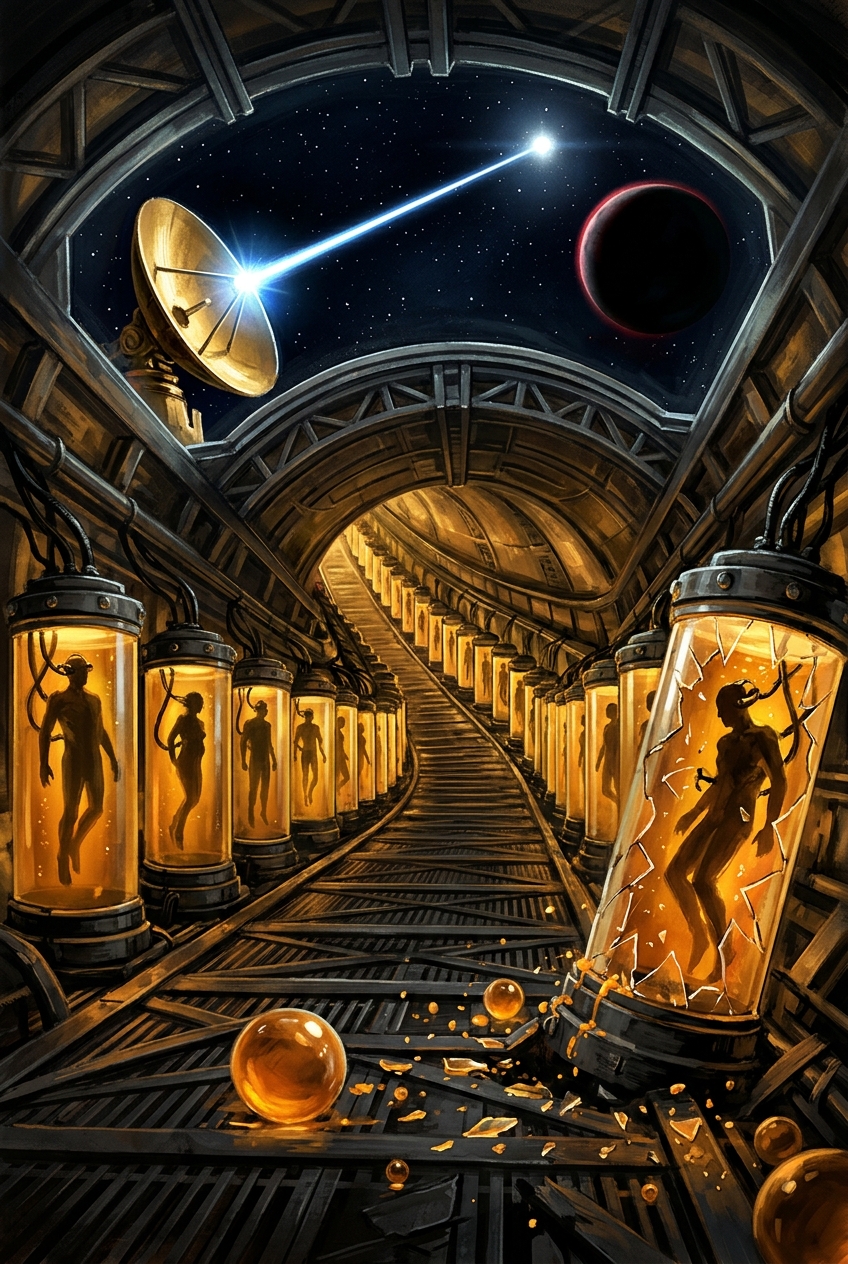
Below the high steel catwalk, arranged in forty concentric tiers that curved upward into the dizzying spin-horizon of the ring, stood three thousand eight-foot cylindrical glass vats.
Eighteen hundred of them were dark and empty on the far side of the gallery.
The nearest twelve hundred were lit from beneath by warm amber growth-lamps, filled with swirling golden-orange amniotic fluid—and floating suspended inside every single glass cylinder, tethered by an umbilical bundle at the navel and a stainless-steel cranial Halo bolted straight into the open top of the skull, hung a full-grown, naked adult human being.
Vance stopped at the catwalk railing, his hands gripping the cold steel bar as a wave of terrible, physical recognition washed up from the soles of his boots.
Directly below them ran Vat-Row 09.
The bodies in Row 09 were at Day 139 of Accelerated Somatic Maturation—forty-eight hours from "decanting." They weren't children growing up; they had been printed directly onto adult scaffolding moulds at age thirty, forty, or fifty. Their eyelids were sealed with clear surgical glue. As their chests rose and fell, pumping the heavy orange liquid fluorine through their lungs, small articulated robotic arms inside the cylinders tracked up and down their pale skin with blue dermatological lasers—burning recorded appendectomy scars, childhood bicycle scratches, and faded military tattoos onto flesh that had never seen the sun or touched the ground.
And at the end of the row, in the Flashing & Decant Gallery, twenty cylinders had already been drained.
In the semi-darkness beneath the orange lamps, twenty wet, naked men and women sat strapped upright in contoured stainless-steel drainage chairs while automated suction tubes cleared the last of the orange fluid from their mouths. Bolted into the unfused coronal sutures across the crowns of their heads, thick black fiber-optic cables hummed with a high, mosquito whine—flashing thirty-five-year-old memories of London rain, dead parents, and paid-off debts into eighty-six billion virgin neurons before a pair of white-suited technicians sealed their skulls with a bone-glue gun and wheeled them next door into the fake white "Cryo-Recovery Bays."
Vance looked down at the empty, draining glass cylinder third from the end of the line.
The stencilled brass plate bolted to its base read: VAT-CELL 09-DELTA.
Currently suspended inside it, floating with his arms outspread in the amber fluid where Arthur Vance had hung fourteen months ago, was a stocky, thirty-five-year-old woman whose boarding placard on the tank monitor identified her as a paediatric nurse from Cardiff.
"Guv," Sabir's voice came quietly beside his ear, her gloved hand touching his sleeve to pull his eyes away from Vat 09-Delta. "Twenty-two minutes to twelve. The bridge lift's at the end of the gantry."
The Auxiliary Flight & Communications Bridge of the CSL Vanguard sat directly above the dorsal spine lock—a hemispherical blister of armoured titanium and flickering telemetry consoles looking out at the sixty-metre parabolic dish of the High-Gain Interstellar Laser Array.
Through the forward viewport, the colossal gold-coated mirror of the laser dish was already locked onto its tiny, invisible target four-point-two-four light-years away across the dark: the yellow pinpoint of Sol, barely brighter than a second-magnitude star against the constellations of Cassiopeia.
On the master uplink console, a green chronometer counted down toward the automated noon financial handshake: TARGET: GREENWICH ROYAL OBSERVATORY / ADMIRALTY & CHARTER CLEARING RELAY PACKET: FLIGHT 117 SAFE-ARRIVAL BOND CERTIFICATE (VALUE: £412,000,000,000) AUTO-IGNITION: T-MINUS 00:19:42
Vance slotted Alistair Finch's gold hexagonal passkey into the primary directorate socket, entered the sixteen-digit override string Finch had written on the green-bar ledger, and plugged Dr Callum Ross's stolen Tartarus data cartridge into the auxiliary telemetry bus.
"We're in," Sabir breathed, her fingers flying across the bridge keyboard as she bypassed the public financial summary packet and began splicing the raw Tartarus directories directly into the core of the outbound Greenwich laser buffer. "Uploading Thomas Barnes's DNA verification... the Hyperion and Sovereign deceleration mass deficits... Kwan's cometary isotope assays... and the full Tartarus Invalid roster."
While the upload bar crawled across the left-hand screen—18%... 24%... 31%—Vance noticed a locked root directory inside the Vanguard's onboard Charter BIOS labeled: PROJECT LAZARUS // THREADNEEDLE STREET ACTUARIAL DIRECTIVE (2096 — EYES ONLY)
Vance touched Finch's Level-One key to the prompt. The file opened.
It wasn't a scientific report. It was a four-page balance-sheet memorandum dated 14 October 2096, addressed to the Court of Directors of the Centauri Starlines Consortium in London and signed by the Chairman, Sir Geoffrey Dyson, and the Chief Actuary.
Vance read the boxed summary table on Page Two:
SUBJECT: POST-FLASH NEUROCHEMICAL IMPRINT DECOUPLING ("THE 24-MONTH DRIFT")
1. Orbital trials aboard Acheron confirm that while CAP-MT destructive scanning and ASM vat-printing achieve 95.8% initial somatic fidelity, all reprinted adult cortices suffer terminal limbic decoupling between Months 21 and 27 post-decant. 2. Engineering a full somatic-endocrine lifelong scaffold would require 38 months of low-speed vat gestation per unit, increasing orbital capital expenditure by 340% and rendering the 36-Month Freehold Charter model insolvent.
3. ACTUARIAL RECOMMENDATION: Do not alter the 140-day vat cycle. By retaining the 24-month biological ceiling while setting Charter Freehold & Pension Vesting at 36 months, the Consortium achieves:
- 100% recapture of all terrestrial Clean-Slate Equity Bonds;
- Zero geriatric, pension, or long-term municipal healthcare liability;
- Elimination of organized colonial labor unrest (average worker lifespan insufficient for union consolidation);
- Complete closed-loop biomass recovery (96% of decanted amino mass returned to agricultural and vat reservoirs upon Month-24 mortality).
DECISION: APPROVED BY UNANIMOUS VOTE OF THE COURT OF DIRECTORS.
Sabir stopped typing for three seconds, reading the screen over Vance's arm.
"Complete closed-loop biomass recovery," Sabir whispered, her face white with fury. "When an Earther dies at Month Twenty-Four and Starlines takes the body under Section Fourteen... they don't burn them in the furnace at Apex. They pump them straight back up the tether to the tanks to print the next ship."
Before Vance could answer, every console on the bridge of the CSL Vanguard flashed blinding crimson.
A deafening pneumatic alarm horn began to whoop along the length of Ring Three, and the upload progress bar on the Greenwich laser terminal stalled at 82% — BUFFER INTERRUPTED.
Across the main directorate display, a security override banner wiped out the actuarial memo: ALERT: LEVEL-ONE TRANSPONDER (FINCH, A. — ID 004) REVOKED AT 11:46:12 REASON: BIOMETRIC HEART-RATE FLATLINE DETECTED AT APEX PLAZA ORBITAL SECURITY PROTOCOL OMEGA ACTIVE // SEALING RING THREE
Vance and Sabir looked at each other.
"Finch didn't wait till eleven-thirty to stage a breakdown," Sabir said grimly, drawing her heavy kinetic service baton and checking the riot-shield latch by the bridge hatch. "Either he drank what was left in his medicine cabinet, or Charter Security threw him through his own six-inch window."
Down below the bridge observation window, at the far end of the half-mile orange-lit womb gallery, the white quarantine blast doors crashed open.
Moving in low-gravity bounds across the catwalks above the amniotic tanks came eight men in pressurized black Starlines Orbital Security armour, carrying magnetic flechette carbines with laser sights cutting red threads through the orange mist—led by a tall, scar-faced Red-Born security commander speaking calmly into a throat mic.
And on the Greenwich laser chronometer beside Vance's right hand, the red message blinked: MANUAL HARDBURN CONFIRMATION REQUIRED AT DISH JUNCTION BOX // T-MINUS 00:11:20
